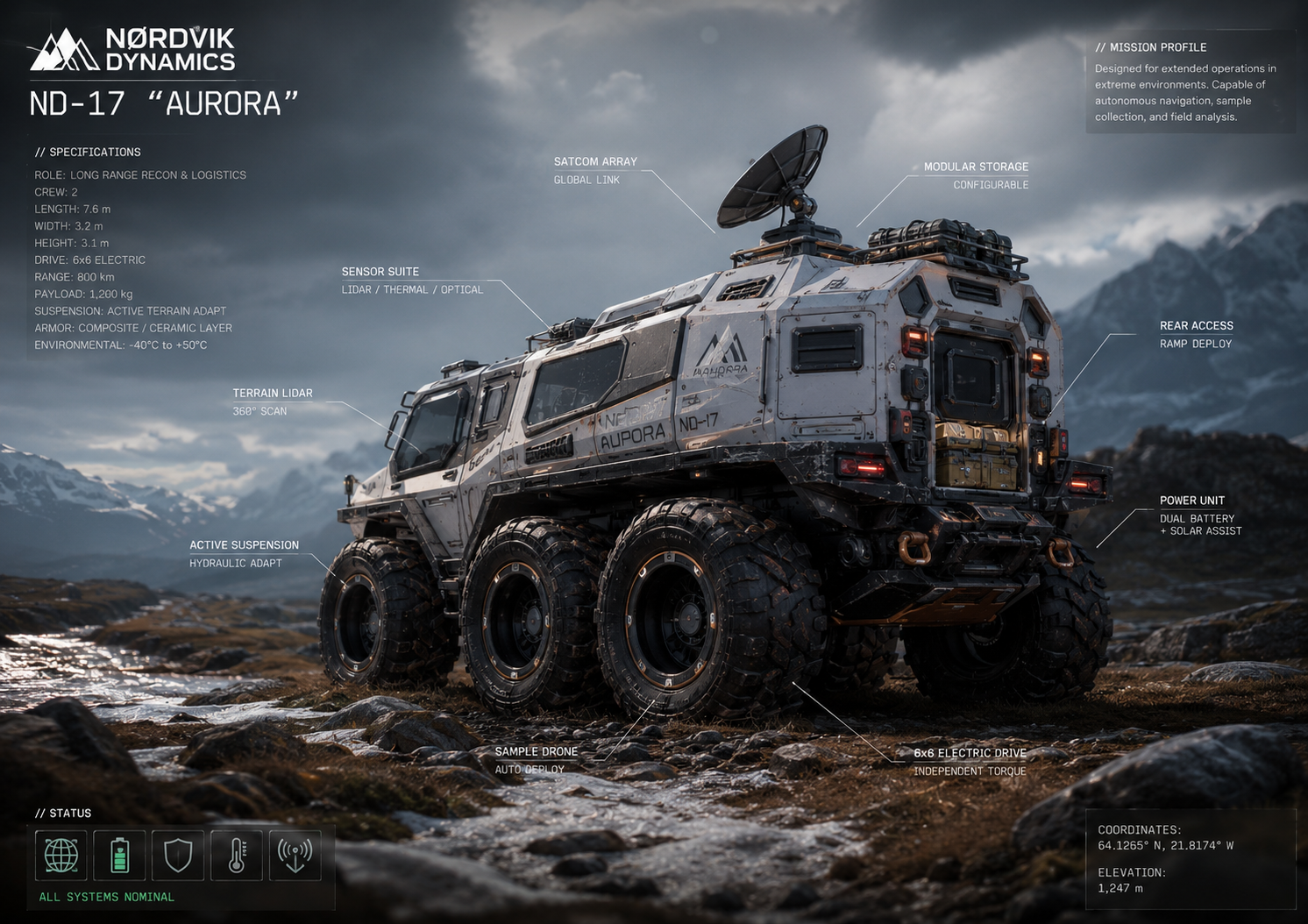
The image that documents itself: doctrine encoded in visual composition alone, recoverable without metadata. A proof-of-concept for the gallery's information architecture.
ND-17 Aurora Mission Rig: Readiness as integrated systems architecture. All information is in the visual composition.
The Constraint Test
Question: Can a single image file with no metadata, no filename context, and no prompt trace encode enough doctrine that meaning is fully recoverable?
Result: This image proves that doctrine survives compression into visual form. The gallery can function as a resource (meaning visible) without requiring extensive metadata.
Definition
Readiness is architecture: integrated subsystems under real constraints. Doctrine readable in visual composition alone.
When To Use
Use when teams claim readiness without integrated systems proof. Use when testing whether doctrine survives compression into form.
⚠️ Critical Reading Note
This is a methodology proof, not a doctrine output.
Framing: Military-adjacent visual language is a systems-thinking metaphor for preparation under uncertainty. Not advocacy, not instruction. The point is integration discipline and the question: "How much structure can be lost before meaning becomes unrecoverable?"
What This Proves: The gallery's information architecture works because doctrine is embedded in artifacts themselves. Surface-level navigation (visual composition + one-line definition) is sufficient for meaning recovery. Supporting metadata enriches but is not required.
Provenance: Created as a deliberate constraint test: Given only a UUID-named PNG file, can meaning be recovered? The answer validates that B1C3 doctrine artifacts can function as self-documenting resources.